

Royal Marine band parading at Dover for the reception of Edith Cavells body, 14 May 1919.

Nurse Edith Cavell (1865-1915)
Edith Cavell (1865-1915) was a British nurse, working in German-occupied Belgium during the First World War. She helped hundreds of British, French and Belgian soldiers escape the Germans and was arrested, tried and executed in 1915.
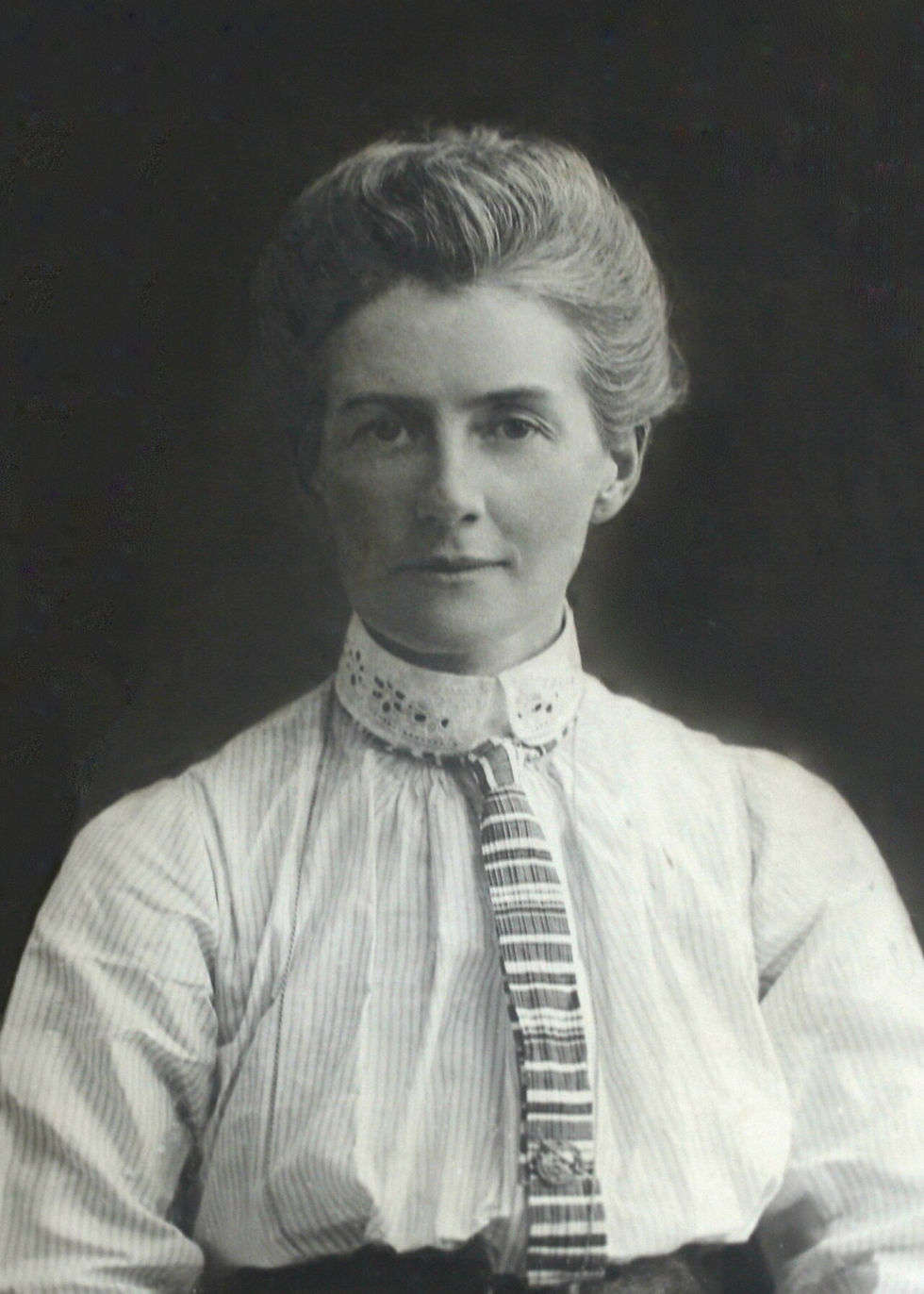
Edith was born in the village of Swardeston, Norfolk.
She was the daughter of a rector and worked as a governess in Belgium, before training to be a nurse in London.
She worked in hospitals in Shoreditch, Kings Cross and Manchester and then accepted a position in Brussels as Matron in Belgium's first training hospital and school for nurses.
There was no established nursing profession in Belgium at the time of Edith's appointment, and her pioneering work led her to be considered the founder of modern nursing education in that country.
She was in Norfolk visiting her mother when the First World War broke out in 1914. On hearing of the threat to Belgium, from the advancing German troops, she felt it was her duty to return to Brussels immediately.
By 20 August, Brussels was occupied by the Germans. The nursing school became a Red Cross hospital, treating casualties from both sides, as well as continuing to treat civilians. In September 1914, Edith was asked to help two wounded British soldiers trapped behind German lines following the Battle of Mons. She treated the men in her hospital and then arranged to have them smuggled out of Belgium into the neutral Netherlands. She became part of a network of people who sheltered Allied soldiers and Belgians eligible for military service, arranging their escape.

Over the next 11 months she helped around 200 British, French and Belgian soldiers, sheltering them in the hospital and arranging for guides to take them to the border. On 5 August 1915, she was arrested for this activity and placed in solitary confinement in St Gilles Prison in Brussels.
Edith was tried at court martial on 7 October 1915, along with 34 other people involved in or connected to the network. She was found guilty and sentenced to death. She was shot by a firing squad at the Tir National, the Brussels firing range, on 12 October 1915.
Although her execution was legal under international law, it caused outrage in Britain and in many neutral countries, such as the United States. She became a symbol of the Allied cause, and her memory was invoked in recruitment posters and messages in Britain and around the world.
After the war, her body was exhumed and escorted to Britain.

As HMS Rowena arrived at Dover on 14 May 1919 a full peal of Grandsire Triples was rung on the bells of the parish church. The peal was notable and reported by the local press at the time,
The ringers … are ex-soldiers, F. Elliot having been eight months Prisoner of War in Germany.
This deep (or full) muffling is normally only used for the deaths of sovereigns.
![Royal Marine band parading at Dover for the reception of Edith Cavell's body, 14 May 1919 [IWM SP 2821]](https://static.wixstatic.com/media/836e27_ef2bde44ccda4b61932c5be52d6b3aaa~mv2.png/v1/fill/w_980,h_716,al_c,q_90,usm_0.66_1.00_0.01,enc_avif,quality_auto/836e27_ef2bde44ccda4b61932c5be52d6b3aaa~mv2.png)
The following day her body was escorted to London for a service of remembrance at Westminster Abbey. Edith’s execution was still a very raw subject and there was a public outpouring of grief, with The Times recording:
At almost every station along the way and at windows near the railway and by the bridges there were crowds of children quietly and reverently watching the passing. The boys saluted, the girls stood silently gazing.

After the service at Westminster, another train transported Edith’s remains to Norwich Thorpe Station.

The coffin was put on another gun carriage and escorted to Norwich Cathedral.
Preceding the coffin were soldiers with reversed rifles, a military band and a large number of nurses.

The Norfolk Regiment provided the pall-bearers for the funeral and one of them was Sgt Jesse Tunmore, who Edith had helped to escape in 1914.
References/ Further Reading:
IWM - Edith Cavell
Edith Cavells Funeral - Centenary by May 15, 2019 by Great War Britain Norfolk
Wikipedia - Edith Cavell

It's incredible to see the historical significance of Edith Cavell's actions and the respect she received upon her return. The Royal Marine band's parade at Dover was a fitting tribute to her bravery. For more on her story and the impact she had, you can visit Cookie Clicker 2, where they have a section dedicated to historical figures like her.
I usually leave a live antique clock restoration stream playing in the background while I answer emails, mostly just for the quiet, mechanical atmosphere. Last night, the feed kept buffering, and the live chat turned guys jerking off live into a huge debate about which independent platforms actually have stable video servers. Someone mentioned as a bizarre but accurate example of a live platform that handles constant real-time traffic without dropping a single frame. I clicked over to inspect the page architecture, and the load times were completely instant. The chat was completely right; the technical optimization and stream stability there are exceptionally efficient. Definitely an unexpected web design discovery during a chill horology broadcast.
Edith Cavell’s story is truly touching, especially the scenes of her final journey and the respect shown by soldiers, nurses, and ordinary people. The details about the bells and crowds make that moment feel incredibly real. I really enjoyed learning about this part of history, then having some fun playing basketball legends, a game with friends online.